Electric Propulsion - Southampton University Spaceflight Society
Electric Propulsion
Thursdays | 18:00 - 20:00
44/1061
Our SUEP project develops, manufactures and tests electric thrusters at the University's David Fearne Electric Propulsion Laboratory. This is rare for access has allowed us to become the first undergraduate society to test fire a Hall-effect thruster in the UK.
Electric propulsion uses electrical energy to accelerate a propellant and so generate thrust. Their exceptionally high exhaust velocity results in incredibly high ISP, efficiency, compared to chemical rockets - albeit at much lower thrust. This defines their advantage as requiring much less fuel mass compared to a chemically powered mission. There are many types of electric thrusters, but these can be split into three broad categories: electrostatic, electromagnetic and electrothermal. It is the component that accelerates the ionised propellant that categorises it. For example, if it is a magnetic field accelerating the propellant: it is electromagnetic, if is the electric field: it is electrostatic.
Our projects, Io-1, Io-2 and Zeus, have all been specifically Hall-effect thrusters (HETs), which are electrostatic systems. A HET uses a magnetic field to confine electrons and create an ionised propellant, then an electric field to accelerate it.
Project Zeus is our latest Hall-effect thruster and currently under development - if you join SUEP within SUSF, you will work on this project. It Is different from our previous HETs as it's propellant is solid zinc, this is very unique and results in new challenges - especially with the propellant delivery system. We hope to complete project Zeus by the end of 26-27 academic year.
Hall-Effect Thruster Database
Before working on the Zeus project, the SUEP team created a database of currently and past Hall Effect Thruster parameters and performances. We want to extend our database of information to anyone interested, which has allowed us to define key design parameters for our Zeus project. References to where the data was gathered has been provided.
Please note that the information we have gathered was openly available online and we have provided references for each source. SUEP wishes to abide by any copyright laws, so please contact us if any data is yours and wish for it to be removed!
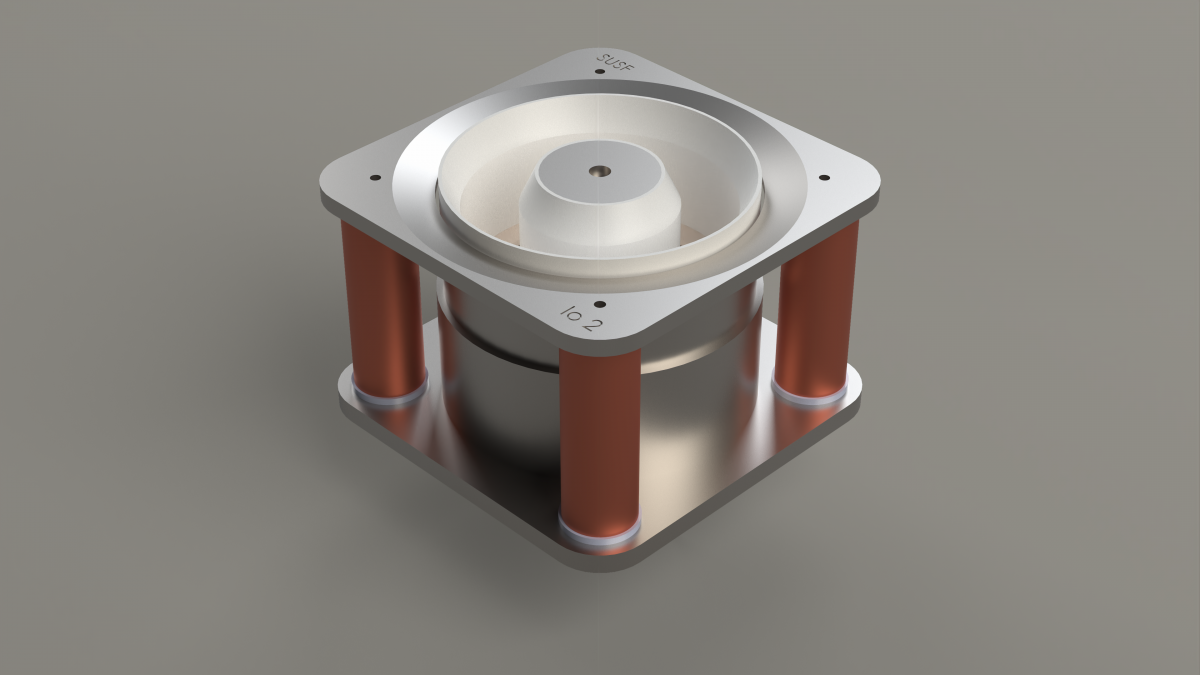
IO-2 is the redevelopment of IO-1, improved with an attempted magnetic shield to resist erosion from high energy ions. Because of this, the team spent much time designing and simulating a magnetic circuit that would enable a successful topology using COMSOL and FEMM. Please look on at the link above to see a much more in depth review of Io-2 design and peformance or to see the publicly available full report.
Io-1
1st UK Society student Hall-effect thruster
Krypton | 250 w
Unstable operation
Lopsided magnetic field topology | Divergent plume
Delayed Ionisation + Acceleration
Io-1 was the first student society built and designed Hall-effect thruster in the UK, as such it has given us the knowledge and skills to develop all our future designs. Being first, it experienced some serious instability and it was impossible to get consistent data points, however, there are two clear lessons from Io-1. From previous simulations of the magnetic field topology, we knew it was not radial and directly resulted in plume divergence. This - alongside the dense plasma region near the exit plane suggesting ionisation and acceleration taking place here - both weaken thrust and performance. These lessons built the foundations of our next thruster Io-2.